Plane Booster
- 4.5
- Rating
- 50.00K
- Installs
- Free
- Price
 Analysis by App-foxy
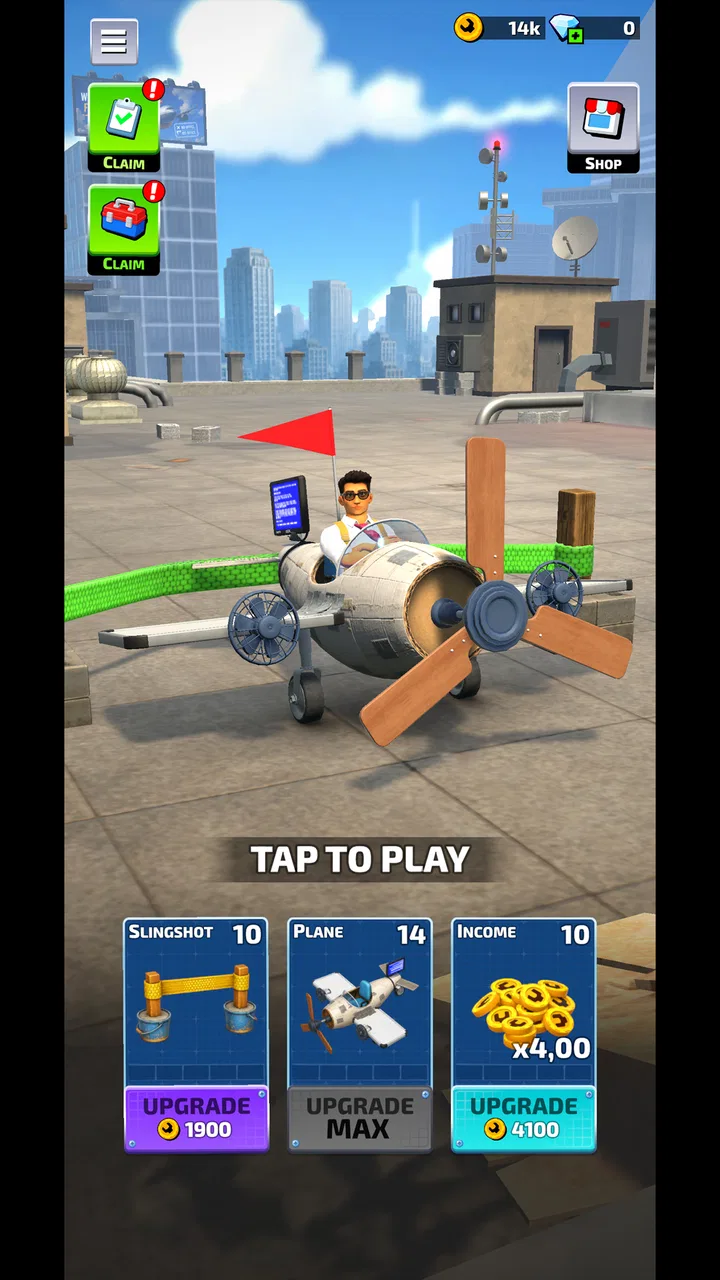
Plane Booster is a free racing game from Kolka Games that turns flying into a simple question of distance, timing, and improvement. Instead of presenting itself as a traditional circuit racer with several vehicles competing on a track, it focuses on pushing a plane farther and using upgrades to make the next attempt more effective. That gives it a very different rhythm from most racing games: each run is short enough to repeat, but the real progress comes from noticing what held the previous flight back.
I found that idea easy to understand within a few minutes. You launch, watch the flight develop, collect the result, and decide what deserves attention before trying again. The store summary describes the goal as flying farther and upgrading smarter, and that is a fair description of the core loop without revealing everything a player needs to learn through practice. The game is listed as suitable for Everyone, so its approachable presentation makes sense, although its repeat-and-improve structure will appeal most to players who enjoy gradual optimization.
How a normal Plane Booster session feels
My baseline workflow was deliberately simple. I started a run without trying to optimize every decision, watched where the plane seemed to lose momentum or opportunity, and then made one meaningful adjustment before repeating the attempt. That habit matters because changing several things at once makes it difficult to understand what actually helped. Plane Booster works best when each flight becomes a small experiment rather than a mindless tap through the same sequence.
You May Also Like

 AccuWeather: Weather Radar
AccuWeather Review: A Quick, Clear Forecast for Everyday Decisions
For everyday plans, the best forecast is the one you can understand quickly. AccuWeather makes rain timing, radar, and local conditions easy to act on, with a few trade-offs.

 Hill Climb Racing
Why Hill Climb Racing Still Turns Crashes Into One More Run
A tiny car, a bumpy hill and one more upgrade: Hill Climb Racing keeps resurfacing because its simple chaos makes every near-miss feel personal.

 AliExpress - Shopping App
AliExpress Makes Global Shopping Feel Personal, but Shoppers Bear the Risk
AliExpress turns a global marketplace into a pocket-sized discovery engine. Its reach is useful, its shopping loop compelling, and its trade-offs easy to miss.

 Lords Mobile: Kingdom Wars
Lords Mobile Is a Kingdom-Building Routine, Not a Quick Match
A case-by-case verdict on the building, battles, device demands, and social commitments that make Lords Mobile rewarding for some players and exhausting for others.

 PDF Scanner app - TapScanner
TapScanner Makes Paperwork Easier to Capture, Check, and Share
TapScanner makes scanning with a phone feel less like a rescue operation and more like a dependable step in getting work done. Its capture tools are useful, though not flawless.

 Block Blast!
 Shows How Much a Puzzle Game Can Leave Out
A quiet grid game shows why puzzle players increasingly value instant clarity, repeatable skill and low-pressure play—and where the genre still needs to catch up.
More From Our News Desk
View All News


This is also where the game separates itself from a conventional racing title. In a kart or car racer, improvement usually means learning corners, braking points, overtaking lines, and track layouts. Here, the focus is more personal and incremental. You are not mainly trying to beat another driver around a fixed course; you are trying to make your own next run travel farther than the last one. Players who like visible progress and repeated attempts will probably settle into that loop quickly.
A useful everyday scenario is a short break when I want something interactive but do not have the attention for a full race. I can begin a run, review the outcome, and make a decision without committing to a long session. That makes the game a better fit for waiting rooms, commutes, or a few spare minutes than a racing game that expects a complete championship event. At the same time, the same structure can feel repetitive if you need constant new tracks, opponents, or dramatic changes of pace.
The most important early choice is not to spend every available improvement immediately. I prefer to identify the part of the run that limits progress most consistently, then direct the next upgrade toward that weakness. If the plane reaches a point where its performance clearly stops improving, a stronger general upgrade may be more useful than a small increase that only helps during the opening moments. This kind of prioritization is more rewarding than simply selecting whichever button is highlighted.
That advice is especially relevant because the game’s appeal is tied to its upgrade cycle. A player who treats every attempt as a reason to press the biggest available improvement may progress comfortably at first, but can lose the sense of control that makes the loop interesting. I got more value from keeping a mental note of what changed between runs. Even without a complicated spreadsheet, remembering whether the last upgrade improved the early launch or the later distance helps prevent random spending.
Settings and preparation that deserve attention
Before settling into repeated flights, I would check the available in-game settings and make sure the controls feel comfortable on the device. In a game built around frequent attempts, small annoyances become noticeable quickly. A player who dislikes the control response or finds the interface difficult to read should adjust what is available before judging the whole experience. The best setup is the one that lets you focus on the flight instead of fighting the screen.
I would also review the phone’s general sound and notification behavior before a longer session. That is not a special Plane Booster feature; it is simply a practical way to avoid interruptions when comparing runs. If you are trying to notice whether a change affects the timing or outcome of an attempt, an unexpected notification can make the result harder to interpret. A quiet, consistent setup makes the game’s small differences easier to recognize.
Because the game is free to install, the first sensible approach is to play naturally before considering any optional purchase. The listed in-app purchase range runs from $1.89 to $54.99 per item, so the cost can vary substantially depending on what is offered in the store. I would not treat spending as part of the basic requirement for understanding the game. First learn whether the repeated-flight loop suits you; only then decide whether paying would improve your personal experience rather than merely shorten the learning curve.
The upgrade screen deserves the same patience as the flight itself. I would look at the wording of each improvement and ask what type of run it supports. An upgrade that helps a weak opening may be valuable when the plane struggles to get started, while another that improves later performance may matter more once the initial launch is already reliable. The practical tip is to match the upgrade to the stage where your run is consistently losing value, not to the most attractive number or button.
Players also often wonder whether this is appropriate for younger users. Its Everyone age rating indicates a broad audience, and the straightforward racing premise is easy to explain. Still, younger players may need guidance around optional purchases, particularly because the game includes items across a wide price range. I would let a child enjoy the free progression first and keep purchase decisions separate from the excitement of a successful flight.
Repeatable patterns that make progress clearer
The fastest way to improve is not necessarily to tap faster. In my experience, it is to create a repeatable routine. Begin each attempt with the same basic approach, observe the result, and change only one variable when possible. This gives you a cleaner comparison between flights. If you alter the upgrade choice, timing, and general strategy together, a better result may feel satisfying but teach you very little.
I also recommend grouping attempts into small practice blocks. Rather than playing indefinitely, make a few runs with one goal, such as understanding the opening or testing whether a particular upgrade changes the later part of the flight. Then pause briefly and decide what the results suggest. This prevents the common mistake of continuing automatically after your attention has faded, when you are no longer learning from each run.
Another useful pattern is to separate progress attempts from observation attempts. During a progress attempt, choose the upgrade or action you believe will improve the result. During an observation attempt, resist unnecessary changes and pay attention to how the run develops. That second type of flight may not produce the biggest immediate distance, but it gives you a baseline. Without a baseline, it is easy to credit an upgrade for an improvement that actually came from a better-timed decision.
Experienced players should keep their own simple priority order. I would usually favor an improvement that removes a repeated weakness over one that makes an already strong part slightly better. This is a trade-off: a balanced plane may produce more dependable runs, while a specialized approach may create a higher result when everything lines up. Plane Booster rewards whichever style keeps you engaged, but the balanced route is easier to evaluate and less frustrating when you are still learning.
There is also a useful stopping rule. If several runs produce nearly the same outcome and you cannot identify a new decision to test, take a break instead of spending resources impulsively. Returning later with a clear question is often more productive than repeating the same attempt while distracted. This is one of the hidden strengths of a simple racing loop: because the rules are easy to remember, you can come back without relearning a large control system.
For players deciding between this and a typical arcade racer, the choice depends on what kind of satisfaction you want. Plane Booster is better suited to someone who enjoys tuning a personal result and seeing a gradual climb. A conventional racer is the better option if you want head-to-head competition, varied courses, drifting, overtaking, or the excitement of a finish line against opponents. Neither approach is automatically superior; they serve different moods.
Where the simple design reaches its limits
The same focused structure that makes Plane Booster accessible can also limit its long-term appeal. If your favorite part of racing games is discovering new environments or mastering a large roster of vehicles, repeated flights may eventually feel narrow. The game’s central loop has to carry much of the experience, so your enjoyment depends heavily on whether incremental improvement remains satisfying after the novelty fades.
I would also avoid expecting a full simulation. The premise is playful and compact, not a detailed aviation experience. Players looking for realistic aircraft handling, technical flight planning, or a deep competitive ranking system should look toward a more specialized alternative. Plane Booster is designed around quick decisions and upgrades, and judging it by simulation standards would miss its purpose.
Another limitation is the temptation to confuse faster progress with better play. Optional purchases may make advancement feel more immediate, but they do not replace learning which choices actually help your runs. Since the listed purchase range reaches from a low-cost item to a much higher-priced one, I would be particularly careful about buying during a moment of excitement. Set a personal spending boundary before playing if you know progression systems can encourage impulse decisions.
Device compatibility is worth checking before installation. The current version is 1.0.3, and the game requires operating system version 12 or later. That requirement is reasonable for many recent phones and tablets, but it means older devices may not be suitable. If you are recommending it to a friend, this is the first practical detail I would mention, especially when the person uses an older phone or keeps a device for several years.
The game has built a visible audience, with more than 50 thousand installs and a 4.5 average from around 944 ratings. Those figures suggest that the basic concept is connecting with players, though they should not replace your own judgment about repetition and spending. The listing also shows 14 written reviews, so I would treat the numerical reception as a useful signal of interest rather than proof that every player will enjoy the same pacing.
Its release date is July 20, 2026, which places the game in an early stage of its life. That makes the current version worth evaluating on its present design rather than assuming a large, mature content ecosystem. The developer, Kolka Games, has chosen a clear starting point: a compact plane-racing loop with upgrades at the center. Whether that foundation remains engaging for months will depend on how much depth you personally find in refining each attempt.
Who should install it and who should pass
I would recommend Plane Booster to players who enjoy short sessions, visible improvement, and the satisfaction of turning a weak run into a better one. It is particularly suitable for people who like idle-adjacent progression but still want to make decisions instead of simply watching numbers rise. It can also work for younger players who understand the basic goal, provided an adult manages purchase permissions and expectations.
I would be more cautious recommending it to someone who wants a complete racing package. If you need multiplayer competition, a deep campaign, realistic vehicle behavior, or constant variety, another racing game will probably be a better match. The plane theme alone should not be the deciding factor. The real question is whether you enjoy repeating a focused challenge and improving through small, deliberate changes.
For new players, my practical recommendation is to spend the first session learning the rhythm rather than chasing the largest possible result. Notice when the flight appears to lose effectiveness, compare upgrades by the problem they address, and keep your decisions consistent enough to learn from them. For returning players, the next step is to create personal rules: one upgrade focus per practice block, no impulsive purchase during a frustrating run, and a break whenever attempts stop providing useful information.
After using that approach, I see Plane Booster as a focused racing game rather than a replacement for a full arcade racer. Its strongest quality is the clarity of its loop: fly, inspect the result, upgrade with a reason, and try again. The trade-off is equally clear: the experience may feel repetitive if you need new tracks or direct competition to stay motivated.
My final verdict is positive, with the right expectations. The free entry point makes it easy to test, the Everyone rating keeps the concept broadly approachable, and Kolka Games has built the experience around a simple habit that can become surprisingly absorbing. I would install it for short, repeatable sessions and judge it by the pleasure of improving my own flights, not by standards borrowed from simulation or multiplayer racing.
In short, Plane Booster is worth trying if you like turning small adjustments into measurable progress. Start without spending, establish a consistent routine, and let your own results show which upgrades deserve attention. If that process feels rewarding, the game has enough focus to become a dependable quick-play option; if it feels like repetition without discovery, a broader racing game will serve you better.
FAQs for Plane Booster
01What is Plane Booster and how does it work?
Plane Booster is an aviation-themed mobile game focused on improving and managing an aircraft as you progress. Players typically complete challenges, earn in-game rewards, and use those rewards to upgrade performance or unlock additional content. The exact gameplay experience can vary by version and device, so it is worth checking the current store description, screenshots, and update notes before downloading.
02Is Plane Booster free to download and play?
Plane Booster can generally be downloaded without an upfront purchase, but availability of optional in-app purchases may depend on the platform and region. These purchases could provide virtual currency, upgrades, extra attempts, or other progression benefits. Before installing, review the app store listing for current pricing and check your device’s purchase restrictions, especially if children may use the application.
03Does Plane Booster require an internet connection?
The connection requirements may depend on the specific version of Plane Booster and the features you want to use. Basic gameplay may work offline in some releases, while advertisements, cloud saving, leaderboards, updates, or in-app purchases can require an internet connection. If reliable offline access is important, confirm the latest developer information and test the game after installation.
04Is Plane Booster suitable for children?
Plane Booster may be accessible to younger players if its controls and objectives are simple, but suitability depends on the age rating, advertising, data practices, and available purchase options. Parents should review the official store rating and permissions before allowing access. It is also advisable to enable parental controls and disable unauthorized in-app purchases on the device.
05What devices are compatible with Plane Booster?
Compatibility depends on the operating system, device model, available storage, and the minimum software version specified by the developer. Before downloading Plane Booster, open the official Google Play or App Store listing and confirm that your phone or tablet meets the requirements. Keeping the operating system updated can also help prevent crashes, installation problems, or performance issues.
Pros
- Simple controls make the game easy to pick up quickly.
- Short levels are convenient for quick gaming sessions.
- Bright visuals give the gameplay a cheerful
- accessible look.
- Progression encourages players to keep improving their flight skills.
- Offline play may be useful when no internet connection is available.
Cons
- Gameplay can become repetitive after extended play sessions.
- Some challenges may feel frustrating without precise timing.
- Ads may interrupt the experience
- depending on the version.
- The game may offer limited depth for experienced players.
- Device performance can affect smoothness on older phones.

Plane Booster
Gallery